
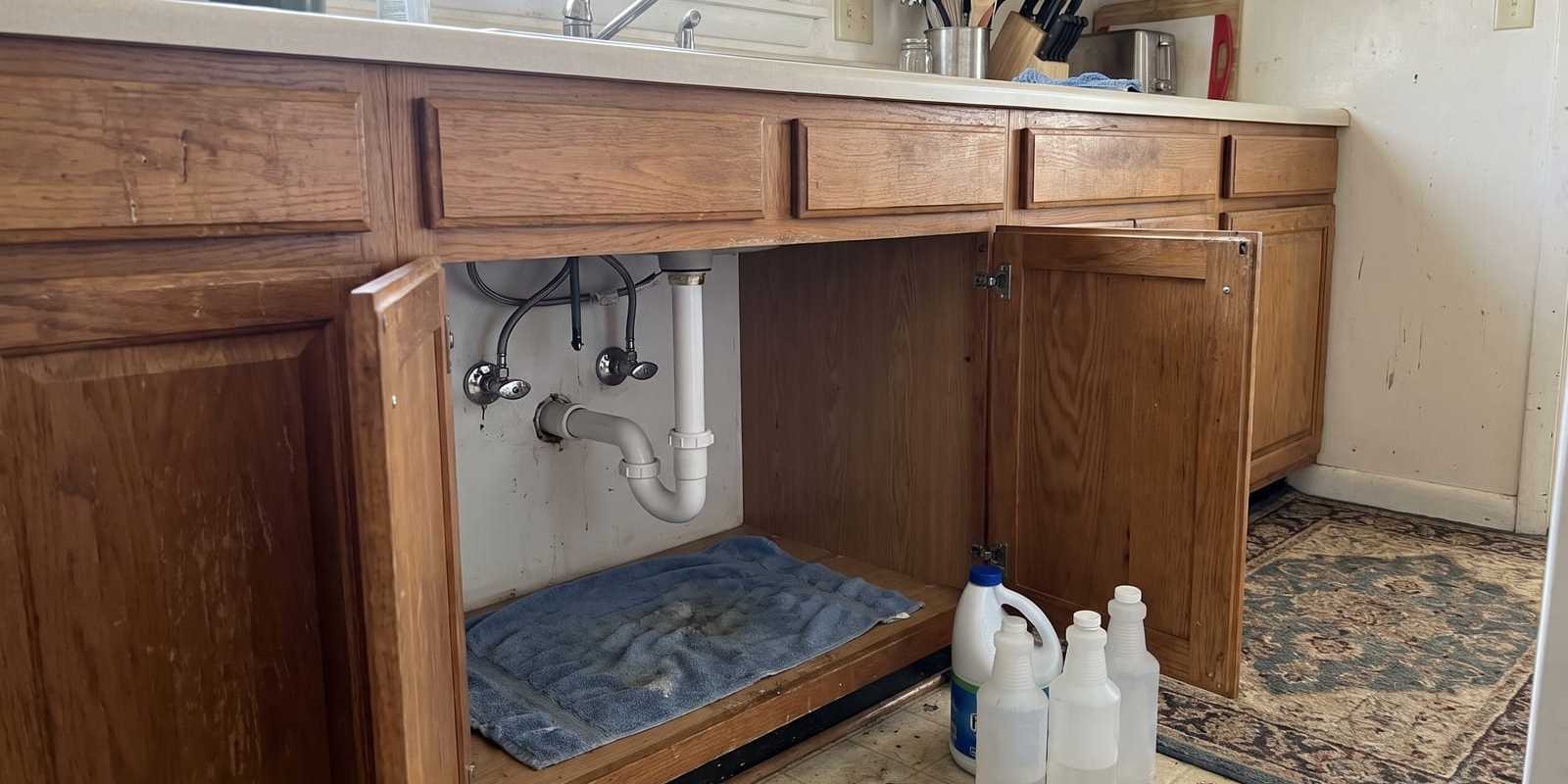
When water is going where it should not, the first five minutes matter more than anything else. Closing the right valve turns a flood into a repair. Answer four quick questions, follow the steps that fit, and call (619) 932-4483 whenever the answer to one of the first three is yes.
Is This an Emergency?
Four Quick Questions
Answer what you can see right now.
Answer the questions, then press the button.
| Symptom | Likely cause | Usual fix |
|---|---|---|
| Water spraying from a pipe or fitting | A burst pipe, a split supply line or a failed fitting | Close the main shutoff; replace the failed section |
| Water coming through a ceiling | A leaking drain, shower valve or supply line above | Close the main; open the ceiling, repair the line |
| Sewage coming up a floor drain or tub | A blocked main line or sewer lateral | Stop using water; clear the main from the cleanout |
| Toilet overflowing and not stopping | A stuck fill valve or a blocked drain | Close the valve behind the toilet; clear or repair |
| Water heater leaking from the tank | A failed tank | Close the cold supply and the gas or power; replace |
| No water anywhere in the house | A closed or failed main valve, or a city shutoff | Check with neighbors and the water district, then the valve |
Storms and Hillside Runoff
Winter storms are when sewer trouble peaks here. Rainwater gets into older sewer laterals through cracked joints and root openings, and an overloaded line pushes back up through the lowest drain in the house. On hillside lots, runoff from the slope above can reach a crawlspace and sit around the pipes and the foundation; water in a crawlspace after a storm is worth a look even when the plumbing seems fine.
What to Do Before the Visit
- Find the main shutoff and close it, or close the valve at the fixture if the leak is clearly there.
- Switch off the power to the wet area at the panel if you can reach it without standing in water.
- Move valuables, electronics, rugs and papers out of the water’s path.
- During a sewage backup, do not run any water or flush any toilet until the line is cleared.
- Photograph the damage and the source before cleanup starts.
Finding the Main Shutoff
Where is the main shutoff in an older La Mesa home?
In many houses from the middle of the last century, the main shutoff is a valve on the pipe where it rises out of the ground at the front of the house, often near a hose bib or under a small cover by the foundation. Some have it in the garage near the water heater, and a few only have the valve at the meter box by the street, which takes a meter key to turn.
Find it before you need it, turn it a little to make sure it moves, and show everyone in the house where it is. An old gate valve that will not turn is worth replacing with a quarter-turn ball valve.
Water and Electricity
What should I do when water is near electrical outlets?
Stay out of standing water that may be touching an outlet, a power strip or an appliance cord. If you can reach the electrical panel without stepping in water, switch off the breakers for the wet area. If you cannot reach the panel safely, keep everyone out of the room and call the utility or an electrician before going in.
Do not unplug anything while standing in water. Once the power is off, close the water shutoff and start moving belongings out of the way.
Water Spreading? Call First
Close the main shutoff, then call with what you see. For anything that can wait, the request form works too.