
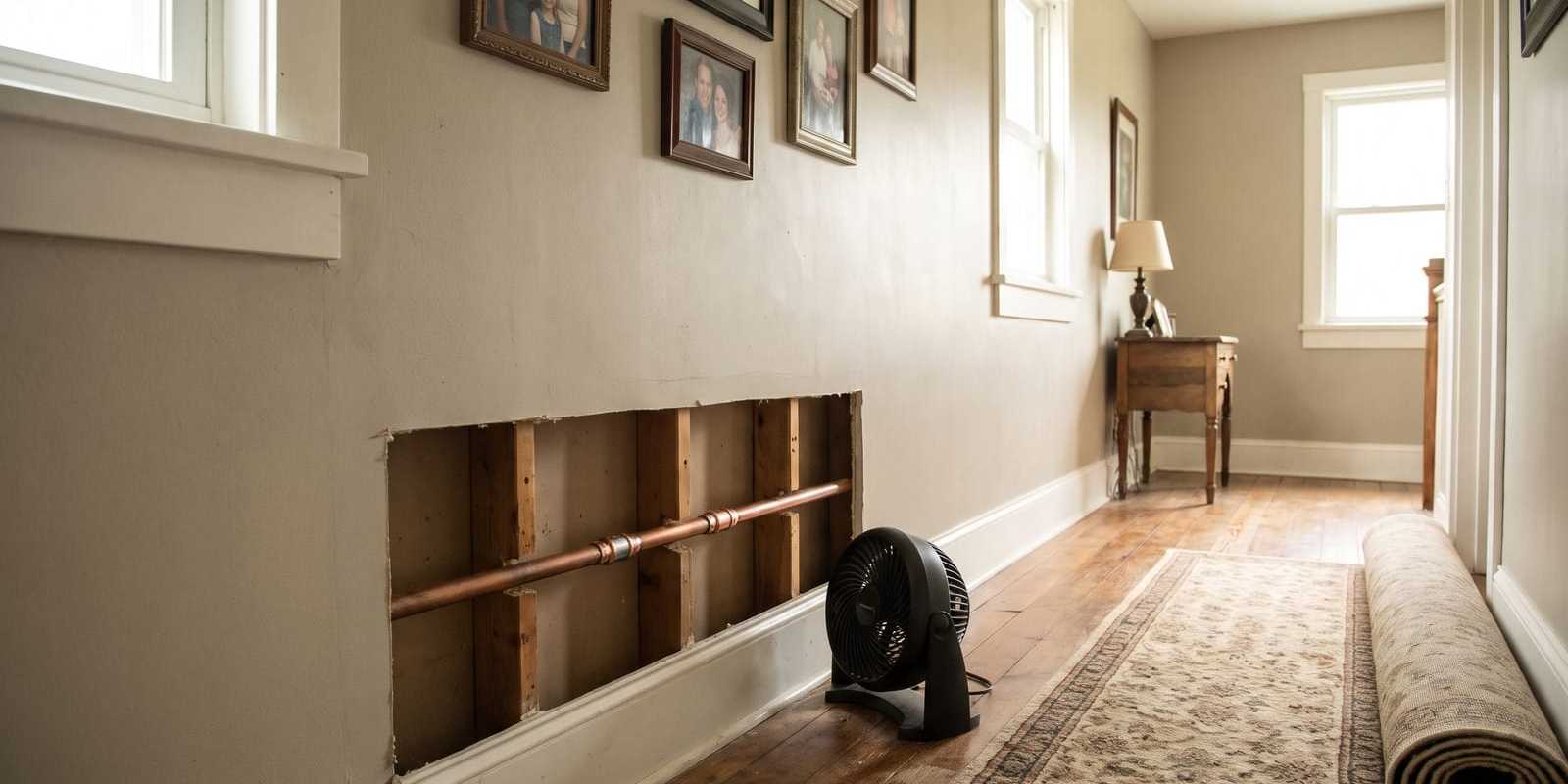
A slow leak does its damage quietly. Water behind a wall or under a floor soaks drywall, rots framing and feeds mold long before it shows as a stain, and a leak under a slab can run for months with nothing to see but the water bill. Finding the source is most of the job; the repair itself is usually straightforward once the leak is in view.
The work covers supply lines, slab leaks, fittings, valves and the fixtures at the end of the line, and, where the pipe is worn throughout, complete residential re-pipes.
| Sign | Likely source | Usual repair |
|---|---|---|
| Water bill jumps with no change in use | A hidden supply leak or a running toilet | Find it with a meter test, then repair the line or the toilet |
| Warm spot on a slab floor | A hot-water line leaking under the slab | Locate the leak; repair it in place or reroute the line |
| Stain or soft drywall on a ceiling | A leaking drain, supply line or shower valve above | Open a small section, repair the line, then patch |
| Damp cabinet floor under a sink | A loose compression nut, a worn supply line or a cracked trap | Tighten or replace the fitting or supply line |
| Hissing in a wall with the taps off | A pinhole in a pressurized line | Open the wall at the sound and replace the section |
| Puddle by the water heater | A dripping relief valve, a fitting or the tank | Fix the valve or fitting; a leaking tank means replacement |
Slabs, Old Copper and Hillside Pressure
Many La Mesa homes are built slab-on-grade, with copper water lines running through or under the concrete. Hard water and years of use wear copper thin from the inside until pinhole leaks appear, often on the hot side first. On the hillside streets, water pressure from the street can run high, and high pressure speeds up that wear and strains every valve and fitting in the house. A pressure check is a sensible part of any leak call.
While You Wait
- Shut off the water: the valve under the leaking fixture if the leak is there, or the main shutoff if you cannot tell.
- Check the water meter with everything off to confirm whether water is still moving.
- Move furniture, rugs, boxes and anything electrical away from the wet area.
- Take photos of the damage and the source for your records and for any insurance claim.
Finding a Leak You Cannot See
How do I find a hidden leak?
Start with the water meter. Close every faucet, make sure the washer, dishwasher and irrigation are off, and look at the meter’s small leak indicator, usually a triangle or a dial. If it moves while nothing is running, water is leaving the system somewhere.
Then narrow it down. Close the toilet supply valves one at a time to rule out a running toilet. Feel the floor for warm spots, look for stains under sinks and around the water heater, and listen at walls for hissing. A leak that still hides after that is a job for a plumber, who uses pressure tests and listening equipment to find it without opening more wall than needed.
One Repair or a New Set of Pipes
Should I repair the leak or re-pipe the house?
One leak in otherwise sound pipe is a repair. The case for a re-pipe builds when leaks keep showing up in different places, when the house still has galvanized supply pipe that has rusted from the inside, or when copper has thinned enough that pinholes appear every few months.
A complete residential re-pipe replaces the worn supply lines throughout the house, so the leaks stop instead of moving to the next weak spot. Gabriel explains what he found and gives the estimate for both paths before any work starts, and you decide.
Stop the Leak Before It Spreads
Call with what you are seeing, or send the request form, and get an estimate before the repair starts.